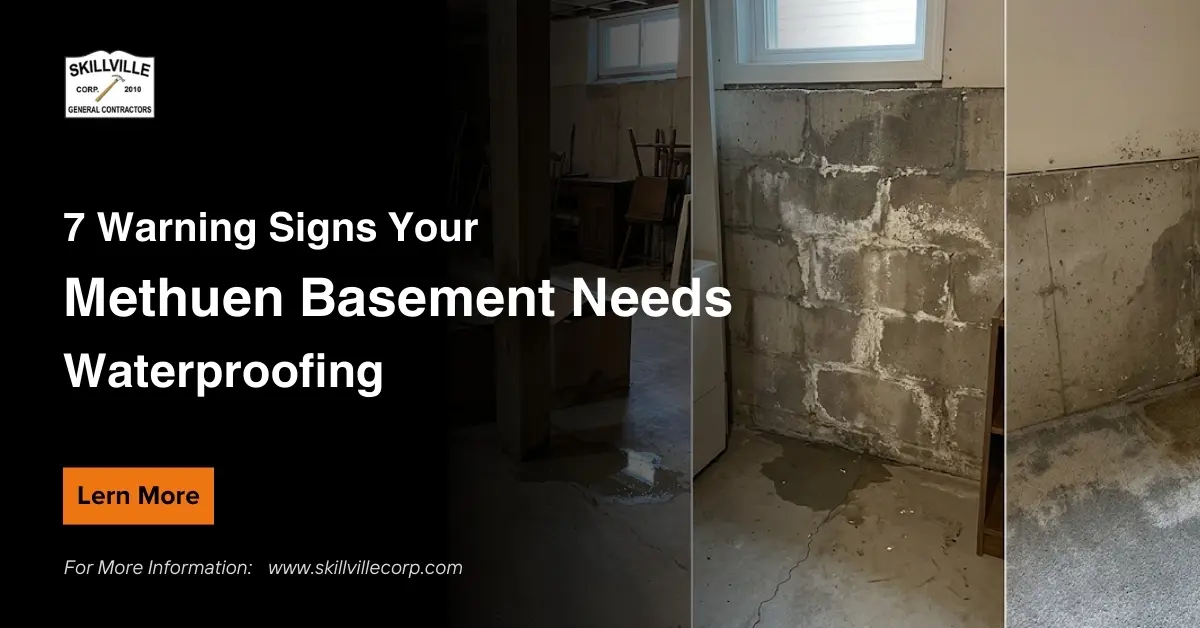
At Skillville Corp., we want you to catch plumbing and foundation problems early. Understanding when your Methuen Basement Needs Waterproofing can save you from huge repair bills and unhealthy mold. Look for visible signs like puddles, damp walls, or a white powdery substance called efflorescence.
Subtle warnings like musty smells, peeling paint, or rusty appliances also mean moisture is trapped inside. In Methuen, seasonal shifts and high water tables create pressure that causes foundation cracks, flaking concrete, or sticking windows. Even wet soil near your house or overflowing gutters can lead to a flooded mess.
The truth is, these problems almost always give you warning signs before they turn into serious structural damage. In this guide, we walk you through the most common signs your basement may need help and what you should do next to keep your home dry and safe.
Key Takeaways
- Methuen basement needs waterproofing is not just about keeping your floors dry. It protects your home’s foundation, your family’s health, and your property value.
- The most common signs your basement needs waterproofing include musty odors, visible cracks, water stains, mold and mildew growth, efflorescence, puddles on the floor, and high humidity.
- New England’s freeze-thaw cycles make Essex County foundations especially vulnerable to crack formation and seepage every spring.
- Most signs of basement leaks require a licensed general contractor or waterproofing specialist, not just a store-bought sealant.
- Acting on early signs can save you thousands compared to waiting for full water damage or mold remediation to become necessary.
- Skillville Corp. offers professional basement waterproofing services in Methuen, MA, for homeowners who want the job done right the first time.
Why Methuen Basement Needs Waterproofing Matters More Than Most Homeowners Realize
Methuen sits in Essex County, Massachusetts, a region known for heavy snowfall, spring snowmelt, and frequent rain events that push water against home foundations from every angle. The clay-heavy soil common in this area holds moisture against your foundation walls for extended periods after rain. Every winter, freeze-thaw cycles cause that moisture to expand inside tiny cracks, widening them season by season.
A general contractor familiar with the Merrimack Valley knows these local conditions well. That context matters when you are deciding between interior and exterior waterproofing methods or trying to figure out why your basement keeps getting damp despite your best DIY efforts.
Without a proper waterproofing system in place, your home’s foundation is constantly fighting a losing battle against water intrusion. When water wins, the consequences range from mold growth and air quality problems to serious structural damage that can cost tens of thousands of dollars to repair.
The good news is that the signs that your basement may need waterproofing show up well before things reach that point. Here are the seven you need to know.
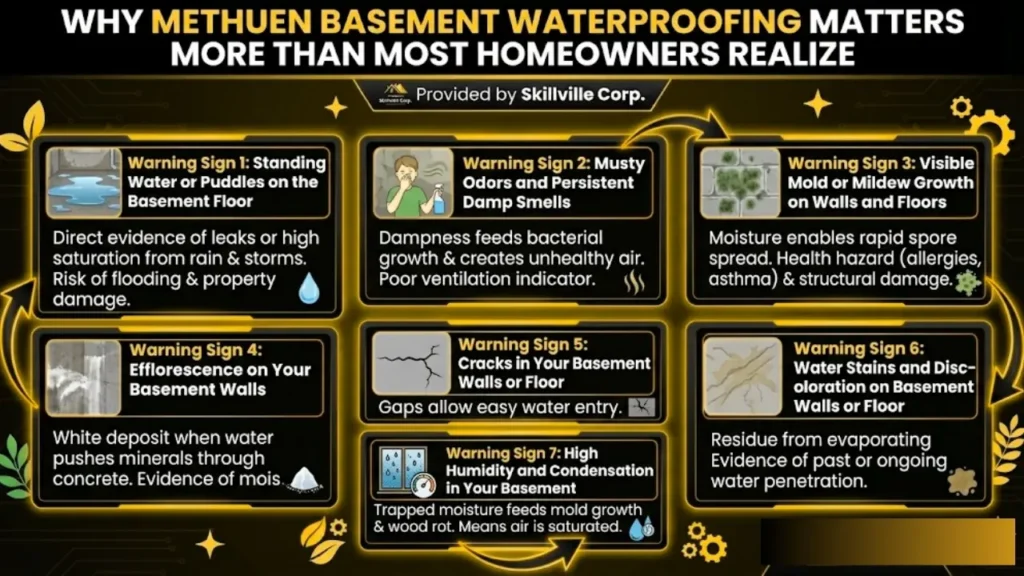
Warning Sign 1: Standing Water or Puddles on the Basement Floor
A puddle on your basement floor after heavy rain is not a minor inconvenience. It is one of the clearest warning signs that water is actively entering your home faster than it can evaporate or drain.
The location matters. Water along the wall-floor joint usually points to water seeping through the foundation from outside. A puddle in the center of the floor often indicates that groundwater is rising up through the concrete slab. Water that appears even when it has not rained recently can signal a high water table or hydrostatic pressure pushing against your foundation walls.
Any standing water in your basement is a red flag. Even small amounts, if they keep appearing, signal a drainage problem that will only get worse. A professional basement waterproofing assessment will identify where the water is coming from and what type of waterproofing solution fits your specific situation.
Warning Sign 2: Musty Odors and Persistent Damp Smells
If you walk into your basement and your nose picks up a musty smell, that is your first indication that something is wrong, even if your eyes do not see anything obvious. A musty smell is often caused by mold and mildew growing in hidden spots, behind insulation, inside wall cavities, or under flooring materials where you cannot see it yet.
Musty odors mean moisture has been present long enough for fungal growth to begin. That typically happens within 24 to 48 hours of water exposure. The musty smell is often a sign that water intrusion has been happening repeatedly over time, not just during the last rainstorm.
Musty smell is often one of the most commonly searched basement problems by Methuen, MA homeowners. And for good reason. It is easy to dismiss as just “basement smell,” but it rarely goes away on its own. Masking it with air fresheners or running a dehumidifier might reduce the odor short-term, but it does not address the underlying moisture problem.
If the damp smell keeps coming back, you need to find and seal the moisture source, not just manage the symptoms.
Warning Sign 3: Visible Mold or Mildew Growth on Walls and Floors
Mold and mildew growth on your basement walls or floor is a step beyond just a musty smell. At this point, the fungus has already taken hold, and you are looking at both a structural concern and a health risk.
Mold thrives in basements because the conditions are often ideal: damp surfaces, limited ventilation, and little natural light. When the humidity in a basement exceeds 50 percent, mold spores that are always present in indoor air find exactly what they need to colonize surfaces. You might notice dark spots in corners, fuzzy growth near the base of walls, or discoloration on your basement floor.
The health implications are real. Mold exposure can trigger respiratory issues, worsen asthma symptoms, and cause allergic reactions, especially in children and anyone with existing health sensitivities. Long-term exposure to some mold types creates more serious health risks.
Scrubbing mold off the surface is not a fix. Without addressing the moisture that feeds it, mold growth will return within weeks. The EPA and CDC both recommend eliminating the moisture source before or during any mold remediation effort. If you are seeing visible mold in your basement, effective waterproofing is part of the solution, not optional.
Warning Sign 4: Efflorescence on Your Basement Walls
Efflorescence is one of the most misunderstood warning signs of a basement water problem. Many homeowners notice the chalky, white deposit on their concrete or masonry walls and assume it is paint peeling, a mineral stain from cleaning products, or something harmless. It is none of those things.
Efflorescence forms when water moves through concrete or masonry, dissolves the mineral salts inside the material, then evaporates at the surface and leaves those salt deposits behind. It looks powdery, chalky, or crystalline, and it almost always appears in white or gray tones.
The deposit itself is not dangerous. However, efflorescence is a definitive sign that water is actively moving through your foundation wall. The more you see of it, the more water has been passing through over a longer period of time.
If you wipe it off and it keeps coming back, your basement is telling you that the water source is still active and the seeping is ongoing. That calls for professional waterproofing, not just a cleaning brush.
Warning Sign 5: Cracks in Your Basement Walls or Floor
Cracks in your basement walls or floor are both a warning sign and a water entry point. Even a hairline crack in a poured concrete wall or a concrete slab can let water seep in during a heavy rain event or a freeze-thaw cycle. And in Methuen, where winter temperatures fluctuate above and below freezing repeatedly from October through April, cracks tend to grow a little wider every single year.
Not all cracks are equal in urgency. Here is how to read them:
Vertical cracks in poured concrete walls are common and often result from normal foundation settling. They can typically be sealed with epoxy or polyurethane crack injection.
Horizontal cracks in block or poured walls are the most serious. They indicate that soil pressure is pushing laterally against the wall, which can lead to bowing and structural damage if not addressed.
Stair-step cracks in block or brick follow the mortar joints at an angle. These usually point to differential settlement and should be assessed by a professional.
If you see any crack that is widening, longer than a few inches, or where water stains are visible on either side, do not treat that as a DIY repair. Foundation repair done wrong can make things worse. Get a professional inspection first.
You can also explore basement remodeling options after repair, once your waterproofing is in place.
Warning Sign 6: Water Stains and Discoloration on Basement Walls or Floor
Water stains are evidence of past and ongoing water intrusion, even in cases where no water is visibly present when you look at your basement today. Tide marks, rust-colored staining, or dark vertical streaks running down your basement walls are all signs of water damage that have been building up over time.
Tide marks are horizontal lines at consistent heights on your walls. They show exactly where water has risen and receded, sometimes repeatedly over multiple seasons. Rust staining shows that water has been in contact with iron in your concrete or with metal objects stored nearby for an extended period.
These stains do not just indicate that water was there once. In most cases, they mean water keeps coming back to the same spot. And each time it does, it carries more mineral deposits, weakens the concrete slightly more, and creates better conditions for mold and mildew to take hold.
If your basement walls or floor have visible staining and you have not yet had a waterproofing system installed, that staining is one of the clearest common signs that you need to act.
Warning Sign 7: High Humidity and Condensation in Your Basement
Your basement does not need to have visible puddles or water stains to have a serious moisture problem. High humidity alone creates the conditions for mold growth, wood rot, and long-term structural damage to floor joists, sill plates, and other wood framing near the basement level.
A relative humidity above 50 percent in a basement is enough for mold to begin colonizing surfaces. In Methuen, MA, summer heat and humidity make this threshold easy to cross in an unprotected basement. In winter, warm interior air hitting cold foundation walls creates condensation on the concrete surface.
You can do a simple test. Tape a piece of plastic wrap tightly to your basement wall and leave it for 24 hours. If moisture forms between the plastic and the wall, water is seeping through from outside. If moisture forms on the outside surface of the plastic, the problem is condensation from indoor humidity. Both issues need to be addressed, but they require different waterproofing methods.
A dehumidifier helps manage ongoing humidity, but does not fix a water entry problem. If your basement consistently feels damp regardless of the season, that damp basement is telling you the waterproofing system is not doing its job.
At a Glance: DIY vs. Professional Basement Waterproofing
Before deciding how to handle the signs above, here is a quick comparison to help you understand what each warning sign typically requires:
| Warning Sign | DIY Possible? | Urgency | Professional Needed? |
| Standing water/puddles | Temporary relief only | High | Yes, a drainage system is required |
| Musty odors | A dehumidifier helps short-term | Medium-High | Yes, the source must be identified |
| Mold or mildew growth | Small areas only, not a fix | High | Yes, waterproofing + remediation |
| Efflorescence on walls | Brushing off is not a fix | Medium | Yes, confirms water migration |
| Cracks in the walls or floor | Hairline only, very limited | High if horizontal | Yes, structural evaluation needed |
| Water stains/discoloration | Cannot fix, only confirms the problem | Medium | Yes, seal the water path |
| High humidity/condensation | Dehumidifier helps | Low-Medium | Depends on the source, inspect first |
The pattern is clear. Most signs your basement needs waterproofing go well beyond what a store-bought sealant or a dehumidifier can handle. The right waterproofing solution depends on where the water is coming from, what type of foundation you have, and how long the problem has been building.
Wet Basement Solutions: What Your Options Actually Look Like
Once you know what warning signs you are dealing with, the next question is what to do about them. Skillville Corp. covers both interior and exterior waterproofing approaches for Methuen, MA, homeowners.
Interior waterproofing involves installing a perimeter drainage system inside your basement that collects water as it enters and directs it to a sump pump for removal. A sump pump system with battery backup is particularly important in Methuen, where spring storms and power outages can happen at the same time. Interior waterproofing does not stop water from entering the wall, but it manages it effectively before it can cause damage.
Exterior waterproofing is the more thorough approach. It involves excavating around the foundation, applying a waterproofing membrane to the exterior wall surface, and installing a footing drain to redirect water away from the structure before it ever reaches your foundation. This is the most complete solution and the one most likely to deliver lasting results.
Foundation repair through crack injection uses epoxy or polyurethane to seal individual cracks and stop water seepage through those specific entry points. This is often done as part of a broader waterproofing project.
You can also check out basement flooring options and remodeling ideas for after your waterproofing is in place, so your basement becomes the finished, usable space you actually want.
To keep your basement dry year-round, combine professional waterproofing with proper exterior grading, clean gutters and downspouts directed away from the foundation, and regular sump pump maintenance.
Frequently Asked Questions
What does Methuen basement needs waterproofing cost, and is it worth it?
Interior drainage system installation typically runs between $3,000 and $10,000, depending on the basement size and severity of the water issue. Exterior waterproofing, which requires excavation, generally costs $8,000 to $20,000 or more. These numbers sound significant, but they compare favorably to the combined cost of foundation repair, mold remediation, and lost home value that result from ignoring water issues. Most homeowners who invest in professional waterproofing consider it well worth it.
How do I know if I need interior or exterior waterproofing?
The right waterproofing method depends on where the water is coming from. If water seeps through your walls, exterior waterproofing addresses the problem at the source. If water comes through the floor-wall joint or the basement floor itself, an interior drainage system with a sump pump is typically the recommended approach. A professional inspection is the most reliable way to determine which method fits your home.
What causes a musty smell in a basement?
A musty smell is almost always caused by mold or mildew growing in damp conditions. Mold produces organic compounds as it grows, and those compounds create the characteristic musty odor your nose picks up. Getting rid of the smell permanently requires eliminating the moisture that feeds the mold, removing existing mold colonies, and improving ventilation. Running a dehumidifier helps control ongoing humidity but does not fix a water entry point or kill established mold.
Is efflorescence a sign I need professional waterproofing?
Yes. Efflorescence, the chalky white deposit on your basement walls, is direct evidence that water is actively moving through your foundation masonry. The deposit is harmless on its own, but its presence confirms an ongoing moisture problem. Light efflorescence in a small area may be something to monitor. Heavy or recurring efflorescence across multiple walls means it is time to call a professional waterproofing company for an inspection.
Can I waterproof my basement myself?
Some minor crack repairs, like injecting a small hairline crack, can be done DIY with the right materials. However, most of the warning signs covered in this article require professional assessment and professional-grade waterproofing methods to fix correctly. DIY sealants applied to the inside of basement walls are generally not a long-term solution for active water intrusion. If you want to safeguard your basement properly, professional waterproofing is worth the investment.
What You Should Do Next
If any of the 7 warning signs in this article look familiar, you now have the information you need to take action before the problem gets worse. Signs that your basement needs waterproofing almost never go away on their own. Water issues in a basement always lead to more serious problems if you leave them alone long enough.
Whether you are dealing with Methuen basement needs waterproofing issues that started after last winter’s freeze-thaw cycles, or you have noticed signs of basement water building up gradually over the past few years, the right move is a professional inspection. A licensed waterproofing company can identify the source of your water problems, explain your options, and give you an accurate picture of what it will take to protect your home.
Skillville Corp. serves homeowners throughout Methuen and the surrounding Merrimack Valley communities.
You can find their location and customer reviews on Google Maps. Do not let a small moisture problem turn into a foundation repair emergency. The earlier you act, the less it costs, and the better off your home will be for it.